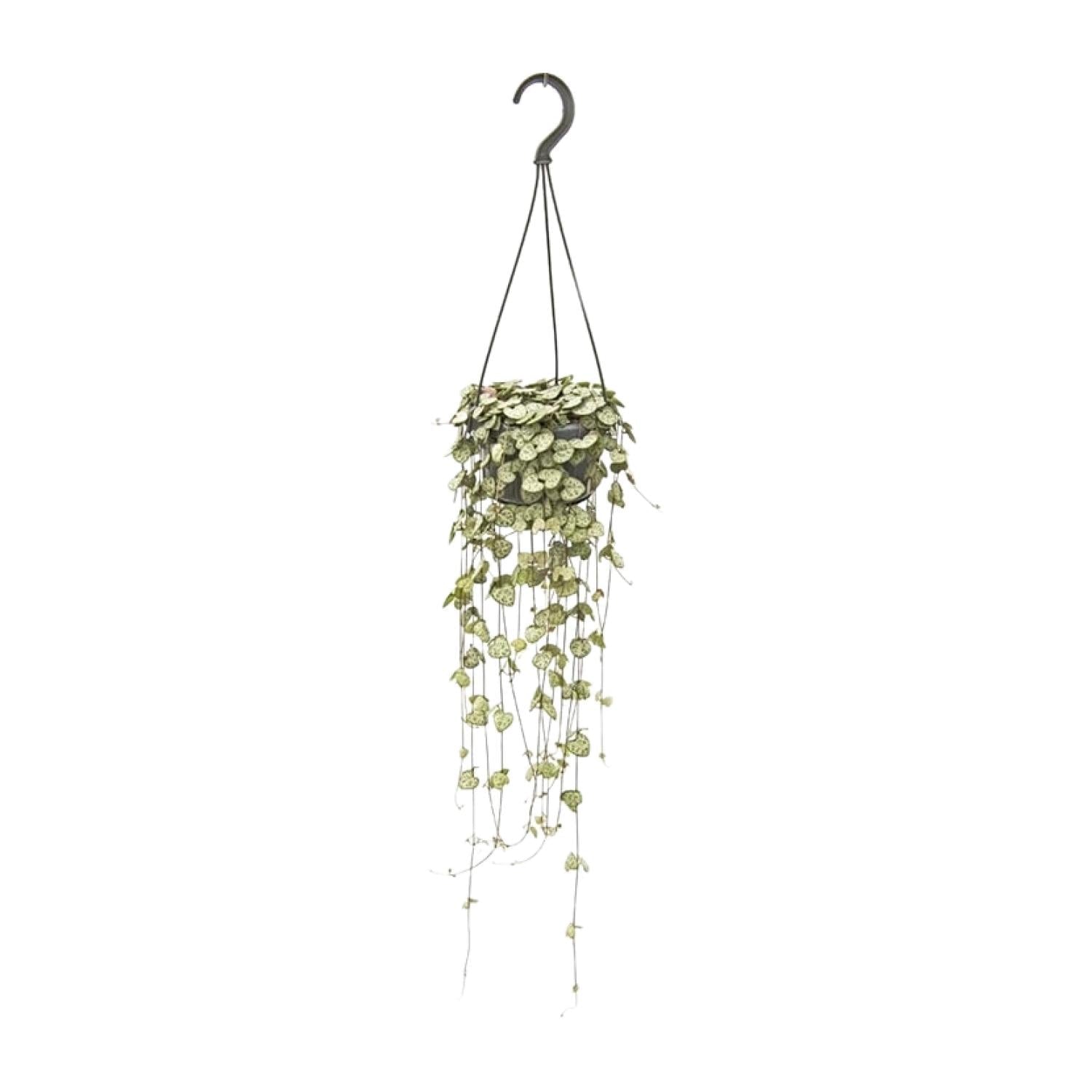

















Ceropegia woodii, affectionately known as the String of Hearts, is one of the most charming trailing plants for your home. With its delicate, heart-shaped leaves that look like they are strung together like a necklace, it quickly captures the hearts of plant lovers. It is not only easy to care for but, thanks to its succulent nature, also very low-maintenance.
Origin & Characteristics
Native to South Africa, Swaziland, and Zimbabwe, Ceropegia woodii belongs to the dogbane family. It develops small tubers both underground and along its stems. These act as water reservoirs, making the plant very resistant to dry periods.
Appearance & Growth
The most striking feature is its silvery-marbled leaves, which often show a purple hue on the underside. The stems of a healthy String of Hearts can grow several meters long with proper care. In the summer, it also produces its characteristic, bizarre flowers that look like small purple lanterns or chandeliers.
The right location for Ceropegia woodii
How much light does the String of Hearts need?
A bright to sunny spot is crucial for your Ceropegia woodii. The more light it receives, the more intense the leaf coloration and the shorter the spacing between leaf pairs. However, avoid direct midday sun in midsummer to prevent burns.
Caring for the String of Hearts & proper watering
When it comes to caring for Ceropegia woodii, restraint in watering is key. Treat it like a succulent: only water when the substrate has almost completely dried out. Waterlogging will inevitably lead to rotting tubers. In winter, reduce watering even further.
Common problems & solutions
Yellow leaves or bare stems
If the leaves turn yellow, the plant is often being watered too much. Bare spots at the base are usually caused by a lack of light. It can help to lay the long stems on top of the pot so that the tubers can sprout new growth.
Natural care support
Although pests are rare, mealybugs can appear in very dry air. To strengthen overall plant health and as natural care support, we recommend using neem oil. It helps keep the leaf surfaces vital and promotes the resilience of the String of Hearts.
Propagating the String of Hearts
Propagation is incredibly easy: simply cut off a stem that has at least one or two tubers and place it on moist soil or put it in a glass of water. New roots will form in no time.
FAQ about the String of Hearts
Is Ceropegia woodii toxic to pets?
Good news: Ceropegia woodii is considered non-toxic to cats and dogs. However, it should be kept out of reach so the delicate stems are not used as toys.
How often should you fertilize the String of Hearts?
During the growth period from spring to autumn, a monthly dose of succulent fertilizer in a weak concentration is perfectly sufficient. It requires no nutrients in winter.
What to do if the stems get too long?
You can prune the String of Hearts at any time. The cut stems can be wonderfully used for propagation to make the mother plant in the pot look bushier.
Take action now: Get your String of Hearts
The String of Hearts is the perfect choice for anyone wanting to garden vertically and looking for a robust beauty. With the right location and moderate watering, it will quickly become an impressive green curtain. Would you like to enrich your home with this romantic trailing plant? Discover our strong Ceropegia woodii in a 14 cm pot now and let yourself be enchanted by its delicate growth!
💚 Pro-tip: The small tubers on the stems can be laid directly into a neighboring pot of soil while they are still attached to the mother plant. This way, they root new growth safely and quickly!